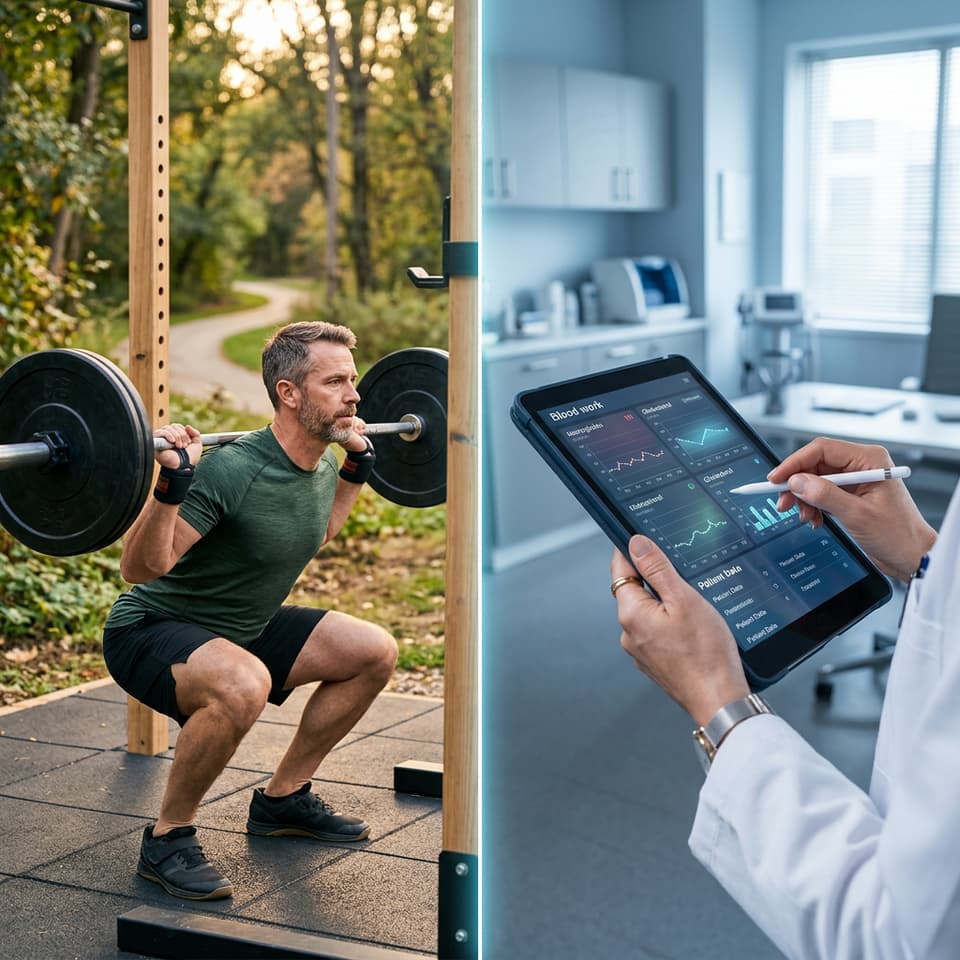
Testosterone and Exercise - How Training Actually Affects Your Hormones
Discover how different types of exercise affect testosterone levels. Evidence-based guide to resistance training, cardio, overtraining, and exercise strategies for men with low T in Colombia.
Quick answer
Cardio, strength, HIIT and overtraining: what each type of training does to testosterone, cortisol and recovery, and how to train for your hormones.
Does Exercise Actually Increase Testosterone?
The relationship between exercise and testosterone is one of the most discussed, and most misunderstood, topics in men's health. Fitness influencers promise that the right workout will "skyrocket" your hormones. Meanwhile, some men train harder than ever and still feel fatigued, weak, and unmotivated.
The truth, as with most things in endocrinology, is nuanced. Exercise does affect testosterone - but the type of exercise, intensity, duration, recovery, and your baseline hormonal health all determine whether that effect is positive, negligible, or even harmful.
This article breaks down the science: which forms of training genuinely support healthy testosterone levels, which can actually suppress them, what the research shows about exercise on TRT, and when training alone is not enough to fix a hormonal deficit. If you are not sure whether your testosterone levels are in a healthy range to begin with, our guide to normal testosterone levels by age is the best place to start.
The Acute Hormonal Response to Exercise
Nearly every form of exercise produces a temporary spike in testosterone - this is called the acute hormonal response. It is measurable, well-documented, and, on its own, largely irrelevant to long-term hormonal health.
A 2016 review by Kumagai et al. published in Endocrine Connections found that resistance exercise, high-intensity interval training, and even moderate aerobic activity all trigger transient testosterone elevations. However, these spikes typically return to baseline within 30–60 minutes post-exercise.
This is important to understand because the temporary post-workout testosterone spike does not mean your resting testosterone levels are changing. The acute response and your baseline hormonal profile are two different things, and it is the baseline that determines whether you experience symptoms of low testosterone or not.
What Actually Matters: Chronic Adaptation
The meaningful question is not whether a single workout raises testosterone for 30 minutes. It is whether a consistent training program, sustained over months, produces lasting improvements in resting testosterone levels. And here, the evidence paints a more complex picture depending on the type of exercise.
Resistance Training: The Strongest Evidence
Of all exercise modalities, resistance training, particularly heavy compound movements, has the most consistent evidence for supporting healthy testosterone levels over time.
A 2021 systematic review published in Sports Medicine examining the effects of resistance training on resting testosterone found that programs incorporating multi-joint exercises (squats, deadlifts, bench press, rows) at moderate-to-high intensity produced the most consistent positive effects on baseline testosterone in previously untrained and recreationally active men.
The key variables that determine whether resistance training supports your hormones include:
- Exercise selection: Compound movements that recruit large muscle groups produce a greater hormonal response than isolation exercises. Squats and deadlifts outperform bicep curls, not just for muscle growth, but for endocrine signaling.
- Intensity: Working at 70–85% of your one-rep max appears to be the optimal range for testosterone response. Light-weight, high-rep training produces a smaller hormonal effect.
- Volume: Moderate volume (3–5 sets of 5–8 reps per exercise, multiple exercises per session) is more effective than either very low or excessively high volumes.
- Rest periods: Shorter rest periods (60–90 seconds) between sets produce larger acute testosterone spikes than longer rest periods, though the chronic effects are less clear.
- Consistency: The hormonal benefits of resistance training require sustained effort, typically 8–12 weeks of consistent training before measurable resting-level changes emerge.
A Practical Framework
Based on the available evidence, a testosterone-supportive resistance training program looks something like this:
| Frequency | 3–4 sessions per week |
| Exercises | Compound movements: squat, deadlift, bench press, overhead press, row, pull-up |
| Sets x Reps | 3–5 sets of 5–8 reps per exercise |
| Intensity | 70–85% of 1RM, progressive overload |
| Rest Periods | 60–120 seconds between sets |
| Session Duration | 45–75 minutes (including warm-up) |
| Recovery | At least 1–2 rest days per week |
This framework is not just about testosterone, it also supports metabolic health, body composition, bone density, and insulin sensitivity, all of which are interconnected with hormonal function.
Cardiovascular Exercise: A Double-Edged Sword
The relationship between aerobic exercise and testosterone is more complicated than the resistance training story, and this is where many men inadvertently work against their own hormonal health.
Moderate Cardio: Generally Supportive
Moderate-intensity aerobic exercise, brisk walking, cycling, swimming, or jogging at a comfortable pace for 30–45 minutes, is generally neutral to mildly positive for testosterone levels. A 2015 study published in the Journal of Science and Medicine in Sport found that moderate aerobic activity improved hormonal profiles in sedentary middle-aged men, likely through its beneficial effects on body composition, insulin sensitivity, and stress reduction.
The hormonal benefits of moderate cardio are largely indirect: it reduces body fat (which lowers aromatase-mediated conversion of testosterone to estrogen), improves insulin sensitivity (insulin resistance is strongly associated with low testosterone), and supports better sleep quality - all factors that contribute to a healthier hormonal environment. For more on how these lifestyle factors interact, see our comprehensive guide to science-backed ways to boost testosterone naturally.
Excessive Endurance Training: A Potential Problem
Here is where the picture shifts. Chronic, high-volume endurance training - the kind practiced by serious marathon runners, ultra-endurance athletes, and competitive cyclists logging very high weekly mileage - has been repeatedly associated with lower resting testosterone levels.
This phenomenon, sometimes called the "exercise-hypogonadal male condition," was described in a 2017 review published in Sports Medicine. Researchers found that male endurance athletes with very high training volumes exhibited testosterone levels significantly below normal reference ranges - sometimes comparable to levels seen in men with clinical hypogonadism.
The mechanisms driving this are multifactorial:
- Chronic caloric deficit: High-volume endurance training burns enormous amounts of energy. Without adequate caloric intake, the body downregulates reproductive hormone production to conserve resources.
- Elevated cortisol: Prolonged training sessions increase cortisol output. Cortisol and testosterone have an inverse relationship — when cortisol stays chronically elevated, testosterone production suffers. Our article on sleep, stress, and recovery explains this cortisol-hormone connection in detail.
- Hypothalamic suppression: The HPG (hypothalamic-pituitary-gonadal) axis — the brain-to-testis signaling system that controls testosterone production — can become suppressed under conditions of chronic physical stress.
- Low body fat percentage: Extremely low body fat, while often seen as a marker of health, can actually impair hormonal function. A minimum threshold of body fat is required for normal endocrine signaling.
This does not mean cardio is bad for testosterone. It means there is a dose-response relationship, and excessive volume without adequate fueling and recovery can tip the balance toward hormonal suppression.
High-Intensity Interval Training (HIIT)
HIIT has been marketed as the "testosterone-boosting" exercise of choice, and the data is moderately supportive.
A 2015 study published in Steroids found that HIIT protocols — short bursts of maximal effort followed by recovery intervals — produced significantly larger acute testosterone responses compared to steady-state cardio of equal duration. Several studies have also shown that HIIT produces more favorable long-term hormonal and metabolic adaptations than moderate-intensity continuous training, particularly in overweight or obese men.
The advantage of HIIT for hormonal health likely comes from its efficiency: it achieves metabolic benefits (fat loss, insulin sensitivity improvement, cardiovascular conditioning) in less time and with less total training volume than traditional endurance exercise — meaning less chronic cortisol exposure and less risk of overtraining.
A practical HIIT protocol for hormonal support:
- 2–3 sessions per week (not daily - recovery matters)
- 20–30 minutes per session including warm-up and cool-down
- Work intervals: 20–40 seconds at near-maximum effort
- Recovery intervals: 60–120 seconds at low intensity
- Cycling, rowing, sprints, or battle ropes all work - the modality matters less than the intensity
The Overtraining Trap: When More Exercise Becomes Counterproductive
There is a recurring pattern seen in men who seek hormonal evaluation: they train intensely, eat carefully, supplement aggressively - and still feel terrible. Their blood work often reveals testosterone levels well below where they should be.
The culprit, frequently, is overtraining - or more precisely, under-recovery.
Overtraining syndrome does not just cause fatigue and poor recovery. It directly suppresses the endocrine system. A review by Kreher and Schwartz published in Sports Medicine documented the hormonal profile of overtrained athletes, finding consistently suppressed testosterone, elevated cortisol, disrupted thyroid function, and impaired sleep architecture - a pattern that mimics clinical hypogonadism.
Warning signs that your training may be suppressing your hormones:
- Persistent fatigue despite adequate sleep
- Declining performance - lifts stalling or going backward
- Chronic joint pain or injuries that will not resolve
- Reduced libido or sexual dysfunction
- Mood changes - irritability, apathy, or depression
- Insomnia or disrupted sleep despite exhaustion
- Frequent illness or slow wound healing
- Elevated resting heart rate
If you recognize several of these symptoms, the solution is not to push harder. It is to get your hormone levels tested and evaluate whether your training-to-recovery ratio is working for or against you.
→ Training hard but feeling worse? Schedule a hormone panel to see what's happening inside.
Exercise on TRT: What Changes When Testosterone Is Optimized
For men receiving testosterone replacement therapy, exercise becomes dramatically more productive, and for good reason.
A meta-analysis by Corona et al. (2016) found that TRT combined with exercise produced significantly greater improvements in lean mass, fat loss, and strength compared to either TRT alone or exercise alone. The combination is synergistic, not simply additive.
Here is what men commonly report after beginning TRT and maintaining a consistent exercise program:
- Faster recovery: Reduced soreness and quicker return to training readiness between sessions
- Improved body composition: Increased lean mass and reduced visceral fat, particularly when combined with metabolic health optimization
- Strength gains: Progressive overload becomes more achievable and consistent
- Better endurance: Improved oxygen-carrying capacity (through red blood cell production) supports aerobic performance
- Enhanced motivation: The drive to train returns - this is one of the earliest improvements reported by TRT patients
Important: TRT does not replace the need for exercise. It removes a hormonal barrier that was preventing exercise from producing the results it should. Men who expect TRT to transform their physique without training will be disappointed. Men who combine optimized hormones with intelligent training will see results they could not achieve before.
For a detailed understanding of what TRT involves, how different delivery methods work, and what to expect from treatment, read our comprehensive guide to TRT injections.
Exercise and Body Composition: The Aromatase Connection
One of the most important indirect pathways through which exercise affects testosterone is body composition — specifically, body fat levels.
Adipose tissue (body fat) contains the enzyme aromatase, which converts testosterone into estradiol (a form of estrogen). The more body fat you carry, the more active this conversion process becomes, and the lower your effective testosterone levels. This creates a negative feedback loop: low testosterone makes it harder to lose fat, and excess fat further lowers testosterone.
Exercise, both resistance training and moderate cardio, breaks this cycle by reducing body fat, improving insulin sensitivity (which independently supports healthy testosterone levels), and increasing lean muscle mass (which improves basal metabolic rate).
Research has consistently shown that even modest reductions in body fat, losing 5–10% of body weight, can produce clinically meaningful improvements in testosterone levels in overweight men. For men already at a healthy weight, maintaining that weight through regular exercise helps prevent the age-related hormonal decline that often accelerates with increasing body fat.
Practical Recommendations: Building a Hormone-Supportive Training Program
Based on the evidence presented in this article, here is a practical framework for training that supports — rather than undermines — healthy testosterone levels:
The Optimal Weekly Template
| Monday | Resistance Training Lower body compound (squats, deadlifts, lunges) |
| Tuesday | HIIT or Moderate Cardio 20–30 min intervals or 30–45 min steady-state |
| Wednesday | Rest or Light Activity Walking, yoga, mobility work |
| Thursday | Resistance Training Upper body compound (bench, rows, overhead press, pull-ups) |
| Friday | HIIT or Moderate Cardio 20–30 min intervals or 30–45 min steady-state |
| Saturday | Resistance Training Full-body or weak-point focus |
| Sunday | Complete Rest Recovery, sleep optimization |
Critical Non-Training Factors
Exercise is only one piece of the hormonal puzzle. Your training will not produce optimal results if these foundations are compromised:
- Sleep: 7–9 hours per night. Research demonstrates that sleep restriction can reduce testosterone by 10–15% in just one week - and the damage goes far beyond testosterone alone.
- Nutrition: Adequate calories and protein (1.6–2.2g per kg of body weight for active men), healthy fats, and micronutrient sufficiency - especially zinc, vitamin D, and magnesium. Focusing on adequate protein, healthy fats, and key micronutrients - especially zinc, vitamin D, and magnesium - provides a practical framework for building meals that support your training and hormones simultaneously.
- Stress management: Chronic psychological stress elevates cortisol, which directly suppresses testosterone production. Training should reduce stress, not add to it.
- Caloric adequacy: Aggressive caloric restriction combined with intense training is a reliable recipe for hormonal suppression. If you are cutting weight, do so gradually - no more than 0.5–1% of body weight per week.
When Exercise Is Not Enough
Here is the uncomfortable truth that fitness culture rarely acknowledges: for some men, no amount of optimized training will fix a genuine testosterone deficiency.
If you have clinical hypogonadism - whether primary (testicular) or secondary (pituitary) - the underlying production capacity is impaired. Exercise can optimize what your body can produce, but it cannot overcome a fundamentally broken production system.
Signs that your hormonal issues may go beyond what training can fix:
- You have been training consistently for 6+ months with proper programming and recovery, but symptoms of low testosterone persist
- Your blood work confirms levels below the reference range despite lifestyle optimization
- You have a known medical condition affecting hormone production (Klinefelter syndrome, pituitary tumor, testicular injury, prior chemotherapy)
- Your levels have declined significantly despite no change in training, diet, or lifestyle
In these situations, exercise becomes a complement to medical treatment - not a replacement for it. The idea that lifestyle changes or training can always substitute for TRT is one of the most persistent myths surrounding testosterone therapy and one that leads many men to delay appropriate treatment. TRT Optima's approach always begins with comprehensive diagnostics to determine whether lifestyle optimization, medical intervention, or a combination of both is appropriate. We do not prescribe TRT when lifestyle changes alone can resolve the issue — and we do not tell men to "just train harder" when their biology needs medical support. For a complete decision framework on when exercise and lifestyle are enough versus when medical treatment becomes the right step, see our guide to TRT vs. natural methods.
If you are in Colombia, whether as a resident or an expat, accessing affordable, quality hormone therapy is straightforward when done through qualified providers. Our city guides for Bogotá and Medellín cover local specifics including laboratory networks and what to expect in each city.
→ Ready to see where your hormones stand? Schedule your comprehensive evaluation with TRT Optima.
Frequently Asked Questions
Does lifting weights increase testosterone permanently?
Consistent resistance training can modestly improve resting testosterone levels over time, particularly in previously sedentary or overweight men. However, the increases are typically modest (10–20%) and depend on factors like training intensity, body composition changes, sleep, and nutrition. It is not a permanent "fix" — the benefits require ongoing consistent training.
Can too much exercise lower testosterone?
Yes. Chronic high-volume training without adequate recovery and nutrition can suppress testosterone levels significantly. This is well-documented in endurance athletes and is related to elevated cortisol, caloric deficit, and hypothalamic suppression. Recovery is as important as training for hormonal health.
What is the best exercise for boosting testosterone?
Heavy compound resistance exercises — squats, deadlifts, bench press, rows, and overhead presses — have the strongest evidence for supporting healthy testosterone levels. These movements recruit large muscle groups and produce the greatest hormonal response. HIIT is also beneficial when performed 2–3 times per week.
Should I change my workout if I start TRT?
You should continue training — in fact, exercise and TRT are synergistic. Research shows that combining TRT with consistent resistance training produces better outcomes in lean mass, fat loss, and strength than either intervention alone. Your doctor may provide specific guidance based on your protocol, but in general, continuing or starting a structured exercise program is strongly encouraged.
How long after starting to exercise will testosterone levels increase?
Acute (temporary) elevations occur immediately after training. Meaningful changes in resting testosterone levels typically require 8–12 weeks of consistent training. The most significant hormonal improvements come from body composition changes, losing excess body fat and gaining lean mass, which generally take 3–6 months to become substantial.
The Bottom Line
Exercise is one of the most powerful tools available for supporting healthy testosterone levels, but it is a tool, not a miracle cure. Resistance training, moderate cardio, and HIIT all play a role in a hormone-supportive lifestyle. Overtraining, excessive endurance work, and inadequate recovery play the opposite role.
The key principles:
- Lift heavy, compound movements - 3–4 times per week at moderate-to-high intensity
- Include cardio wisely - Moderate amounts support hormones; excessive volume suppresses them
- Prioritize recovery - Sleep, nutrition, and rest days are not optional
- Monitor your body - If symptoms of low T persist despite good training, get your levels tested
- Know when to seek help - Exercise cannot fix every hormonal problem, and responsible medical intervention exists for a reason
Your hormones and your training should work together. If they are not, the answer is not to guess, it is to test, evaluate, and act on data.
If you want to understand whether you actually need medical treatment or whether lifestyle changes are enough, our TRT vs. natural methods decision guide walks through the complete framework.
Schedule Your Free Hormone Evaluation with TRT Optima →
This article is educational and does not replace professional medical advice. Diagnosis, prescriptions and treatment decisions are made by licensed physicians.