
Testosterone Blood Tests - When to Test, Whether to Fast, and How TRT Changes the Rules
Diagnosis and TRT monitoring need different testing rules. What actually matters — fasting, morning timing, and trough testing - explained clearly.
Quick answer
When to book a testosterone test, whether to fast, how sleep and training skew results, and how timing changes once you’re on TRT.
A testosterone blood test seems simple: show up, get your blood drawn, get a number back.
In practice, several easily overlooked details, whether you're being diagnosed or monitored, the time of day, fasting status, and, for anyone already on injectable treatment, timing relative to your last dose, can meaningfully change what that number actually shows. Getting these details right is not a formality. It is often the difference between a result your physician can actually act on and one that sends you down the wrong path entirely.
Diagnosis vs. Monitoring: Two Different Situations, Two Different Rules
Most articles on this topic treat "how to prepare for a testosterone test" as one universal answer. It isn't. The right preparation depends heavily on which of two very different situations you're in.
If you are being evaluated for possible low testosterone for the first time, your body's natural circadian rhythm is the dominant factor, and fasting morning testing is the standard major guidelines recommend.1, 4 If you are already receiving injectable TRT, your body's normal rhythm has been substantially altered by exogenous testosterone, and the timing of your blood draw relative to your injection becomes the more important variable to control.
If You're Being Evaluated for Low Testosterone: Morning Fasting Testing
Testosterone follows a well-documented circadian rhythm, generally highest in the early morning and declining across the day. This is not a minor effect. Published research directly comparing testosterone therapy pharmacokinetics to endogenous diurnal variation confirms this daily rhythm is well established in healthy men, and that men with genuine testosterone deficiency characteristically lack this normal variation, showing a flatter profile throughout the day instead.2 This is precisely why the Endocrine Society's clinical practice guidelines recommend that adult men being screened for androgen deficiency have their initial testosterone level drawn in the morning.1
For an initial diagnostic evaluation, fasting morning testing provides a standardized result and aligns with major clinical guideline recommendations. If your panel also includes glucose, insulin, triglycerides, or other metabolic markers, which a comprehensive hormone evaluation typically does, following your lab's specific fasting instructions becomes even more important, since those markers are directly affected by recent food intake in a way that a single testosterone reading is not.
Acute illness is also worth flagging clearly at this stage specifically: testing during a significant illness, particularly with fever, can temporarily suppress testosterone independent of your actual baseline status, and a diagnosis made from a result drawn during that kind of illness can be genuinely misleading. If you're unwell, it's worth rescheduling rather than testing as planned.
If You're Already on Injectable TRT: Why Injection Timing Matters More Than Time of Day
Once you start injectable testosterone, your body's natural circadian pattern is no longer the dominant factor shaping your levels. Instead, your levels rise after each injection, reach a peak over the following days, and then gradually decline until your next scheduled dose, at which point the cycle repeats. This means the same man, on the exact same protocol, can produce meaningfully different lab results depending purely on which day of his injection cycle he happens to get tested, a bigger source of variation at this stage than what time of day he shows up.
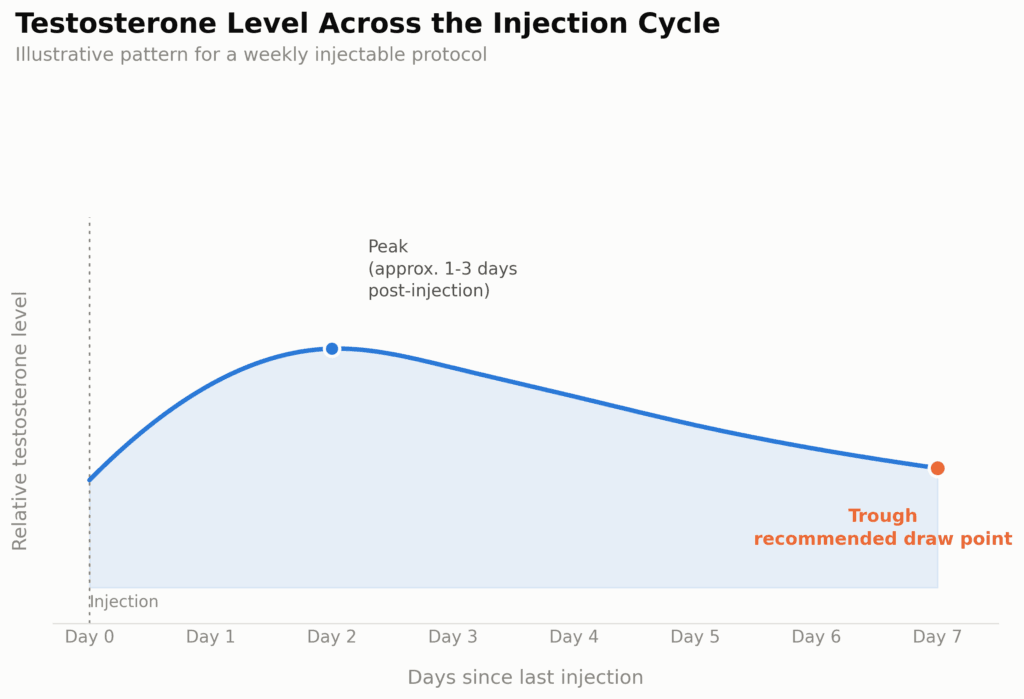
This is where terminology matters, and where clinical practice is genuinely more varied than most articles on this topic acknowledge. Some approaches measure testosterone at the midpoint between injections; others deliberately measure at trough, the lowest point in the cycle, immediately before the next dose. Both approaches can be clinically useful, and the specific number you get will differ depending on which one your provider uses. What matters most is knowing which measurement you're taking and being consistent about it from one visit to the next.
At TRT Optima, we standardize injectable TRT monitoring at trough, immediately before the next scheduled injection, so that every follow-up measurement is taken at the same comparable point in your dosing cycle. A trough measurement tells your physician how low your serum testosterone is falling before the next dose. Combined with your symptoms, other laboratory markers, including hematocrit and estradiol when clinically indicated, and your dosing schedule, that information helps your physician assess how your protocol is performing across the injection interval, not just on the day of the test.
| Once weekly | Immediately before the next weekly injection |
| Twice weekly | Immediately before the next scheduled injection |
| Every other day / very frequent dosing | Follow your physician's specific instructions; peak-to-trough variation is smaller with this frequency |
| Recently changed dose or frequency | Wait until your physician instructs you before repeating labs, testing too soon after a change can be misleading in either direction |
What If You Use Testosterone Gel, Cream, or Pellets?
Blood-draw timing is formulation-specific, and injectable protocols are not the only situation this applies to. Topical gels and creams have very different pharmacokinetics from injectable testosterone, and the timing of bloodwork relative to application can meaningfully affect the result. Pellets release testosterone gradually over months rather than in a weekly or twice-weekly cycle, which changes the timing question again. If you are using a formulation other than standard injectable testosterone, confirm the correct draw timing for your specific protocol with your physician rather than assuming the injectable trough approach applies.
Before Your Test: The Practical Checklist
- If you're being diagnosed, test in the morning, fasted - this is the standard your reference ranges are actually built on
- If you're on TRT, test at your consistent, physician-confirmed timing point - typically trough for injectable protocols at TRT Optima
- Get a normal night's sleep beforehand - even one night of significantly shortened sleep can measurably lower testosterone the following day, distorting a result meant to reflect your typical baseline3
- Avoid doing anything unusually different from your normal routine immediately before testing - extremely strenuous or prolonged exercise can transiently affect several laboratory markers, so consistency between tests is what matters most, not avoiding your normal training entirely
- Take your medication normally unless specifically told otherwise - don't skip a dose or alter your injection schedule in an attempt to make your labs look a certain way; this distorts the very information your physician needs
- Stay adequately hydrated - dehydration can affect several lab values beyond testosterone itself and can make the blood draw itself more difficult
Don't Try to "Pass" Your Blood Test
This happens more often than most patients realize. Sleeping unusually well for two nights beforehand, skipping training, dramatically changing diet, quietly adjusting injection timing, skipping a dose, overhydrating, or adding a supplement right before a test, all in an attempt to produce a "better" looking number.
The goal of a blood test isn't to produce the best-looking result. It's to produce a result that accurately represents how your body normally functions under your current treatment protocol. A result that's been engineered to look good isn't useful information, it actively works against your physician's ability to make the right call about your actual protocol, and it can lead to a dose that's wrong for how you actually live day to day, not just on testing day.
What a Complete Panel Actually Includes: Before TRT vs. During TRT
The right panel is not identical before you start treatment and after you're already on it, and this is a distinction most general content on this topic misses entirely.
Before Starting TRT (Diagnostic Workup)
- Total testosterone
- Free testosterone and/or SHBG where appropriate
- LH and FSH - important when evaluating the cause of low testosterone and distinguishing primary from secondary hypogonadism, which changes the treatment approach entirely
- Complete blood count
- Relevant metabolic markers
- Additional markers as clinically indicated
During Ongoing TRT (Ongoing Monitoring)
- Testosterone (at your standardized timing point)
- Complete blood count / hematocrit
- PSA where age-appropriate
- Estradiol when clinically indicated
- Relevant metabolic and cardiovascular markers
LH and FSH are generally suppressed by exogenous testosterone once you're on treatment, which is exactly why they're central to the initial diagnostic workup but not typically repeated as part of routine ongoing monitoring. Our complete guide on interpreting testosterone labs explains what each of these markers means in more depth.
TRT Optima's Actual Monitoring Schedule
At TRT Optima, patients beginning TRT typically repeat laboratory testing approximately eight weeks after starting treatment. Once the initial protocol has been assessed, testing is generally repeated three months later, and then approximately every six months when treatment, dosing, symptoms, and laboratory markers remain stable. Significant dose changes, new symptoms, or abnormal findings may require earlier testing outside this standard schedule. Our guide on what to expect during your first year of TRT explains where each of these check-ins fits into your broader treatment timeline, and our guide on TRT injections, types, and frequency covers how different injection schedules affect the cycle discussed above.
Common Mistakes That Skew Results
- Testing in the afternoon or evening during a diagnostic workup - misses the natural morning peak your reference range is based on
- Testing too soon after an injection while on TRT - captures a temporarily elevated peak rather than your standardized trough, and can trigger an unnecessary dose reduction
- Inconsistent timing between visits - even if each individual result is technically valid, comparing a peak-timed draw to a trough-timed draw from a previous visit can look like a meaningful change when it's actually just a timing artifact
- Testing during acute illness - especially relevant during initial diagnosis, since fever and acute illness can temporarily suppress testosterone independent of your actual status
- Not disclosing a recent dose or protocol change - your physician needs this context to interpret a result correctly, particularly in the weeks immediately following an adjustment
- Altering your normal routine specifically to influence the result - this produces a number that doesn't reflect how your body actually functions day to day
Frequently Asked Questions
Do I need to fast before a testosterone blood test?
For an initial diagnostic evaluation, fasting morning testing provides a standardized result and aligns with major clinical guideline recommendations. If your panel also includes glucose, insulin, or a full lipid profile, following your lab's specific fasting instructions becomes even more important, since those markers are directly affected by recent food intake.
Can I drink water while fasting for testosterone bloodwork?
Yes. Unless your laboratory specifically instructs otherwise, plain water is generally fine during a fasting blood test, and staying normally hydrated can make the blood draw itself easier. Avoid caloric drinks, coffee with milk or sugar, and anything else prohibited by your laboratory's specific fasting instructions.
What does "trough" mean, and is it always the right way to test on TRT?
Trough refers to the lowest point in your testosterone level, occurring immediately before your next scheduled injection. Clinical practice varies, some providers measure at trough, others at the midpoint between injections. At TRT Optima, we standardize at trough so every follow-up result is comparable to the last. What matters most is knowing which approach your provider uses and testing consistently the same way each time.
What happens if I test right after an injection instead of at trough?
Your result will likely reflect an elevated, peak-influenced level rather than your standardized baseline. This can lead to a dose being reduced unnecessarily, since your physician would be reacting to a temporarily high number rather than your actual trough exposure.
Does the time of day matter once I'm already on TRT?
Less than it does before you start treatment. Once your levels are being driven by an injection cycle rather than your natural circadian rhythm, consistent timing relative to your last dose becomes the more important variable to control.
Should I test if I'm feeling sick?
It's generally best to wait, particularly if you're being evaluated for a diagnosis. Acute illness, especially with fever, can temporarily suppress testosterone independent of your actual hormonal status, which can distort your result.
I recently changed my dose. When should I get tested?
Enough time needs to pass for your levels to reach a new steady state before a test will accurately reflect the change. Testing too soon after an adjustment can be misleading in either direction. Confirm the right timing with your physician rather than guessing.
Should I skip my injection or change my routine before a test to get a better result?
No. The goal of testing is to accurately capture how your body functions under your actual, normal protocol, not to produce the best-looking number. Altering your routine specifically for the test gives your physician inaccurate information to work with.
The Bottom Line
There isn't one universal way to prepare for every testosterone test. How you should prepare depends on whether you're being diagnosed or already being monitored on treatment, and consistency matters enormously either way. For an initial evaluation, fasting morning testing is the standard your reference ranges are built on. Once you're on injectable TRT, consistent timing relative to your injection schedule becomes the variable that actually determines whether your physician is working with an accurate picture.
At TRT Optima, this distinction is built into how we structure every evaluation and every follow-up, not something you need to know to ask about. Start your Free Hormone Evaluation. If you already have recent bloodwork, you can upload it for review. If you need new testing, we can help coordinate appropriate bloodwork through our partner laboratories in Colombia. Once your results are available, our physicians provide a comprehensive hormone evaluation with findings and recommendations. Get started here.
Sources
- Bhasin S, Brito JP, Cunningham GR, et al. Testosterone Therapy in Men With Hypogonadism: An Endocrine Society Clinical Practice Guideline. Journal of Clinical Endocrinology & Metabolism. 2018.
- Pastuszak AW, Gittelman M, et al. Pharmacokinetics of testosterone therapies in relation to diurnal variation of serum testosterone levels as men age.
- Leproult R, Van Cauter E. Effect of 1 week of sleep restriction on testosterone levels in young healthy men. JAMA. 2011.
- American Urological Association. Testosterone Deficiency Guideline.
- Kaminetsky JC, McCullough A, Hwang K, Jaffe JS, Wang C, Swerdloff RS. A 52-Week Study of Dose Adjusted Subcutaneous Testosterone Enanthate in Oil Self-Administered via Disposable Auto-Injector. The Journal of Urology. 2019;201(3):587-594.
This article is educational and does not replace professional medical advice. Diagnosis, prescriptions and treatment decisions are made by licensed physicians.